THE SITUATION
Juggling it all, every single day
The people I work with have achieved a great deal. They carry responsibility, make decisions and hold a lot together. And almost all of them know moments like these:
AT WORK
A decision keeps running at three in the morning, even though all the figures are on the table.
Conflict and ambiguity take more energy than the work itself.
The holiday is booked, but the emails come along anyway.
AT HOME
At dinner, your mind is still at work, and your family notices.1
Conversations revolve around schedules and logistics, and hardly ever around each other.
There is hardly any time left for what matters to you.
IN THE ORGANISATION
Good people fall short of their potential, and no one can quite say why.
New programmes launch with great energy and are forgotten three months later.
Conflicts are often postponed rather than resolved.
70%
of their holiday days, CEOs still work2
20%
of employees worldwide are truly engaged3
CHF 6.5bn
is what work-related stress costs the Swiss economy every year4
It is not a lack of commitment. Almost everyone wants to give their best.
THE HOPE
Optimise wherever possible
And so people optimise. Personally, with time management, books, coaching, wearables and longer holidays. In organisations, with leadership programmes, resilience training and change initiatives.
Each of these measures is well meant, and some help for a while. But as soon as the pressure rises, much of it slips back to the way it was. And the time gained is booked up again faster than it was won.
Why is that? The will is there, and so are the means. But even with your foot hard on the accelerator, you burn a lot of energy and barely move forward if the other foot is on the brake.
THE TRUTH
What holds you back usually goes unnoticed:
unconscious stress.
Most measures focus on individual aspects of life: sleep, communication, time management, team culture. Each is valid in its own right, but often treats only the symptoms, because few people know where the greatest lever for realising their own potential lies.
HUMAN INTELLIGENCE
Staying composed, judging clearly, being present: you do not need to acquire these on top of everything else. They are our natural human state. Being able to draw on these abilities consciously in everyday life, because you understand yourself deeply, is for me the core of Human Intelligence.
What often blocks this natural state is unconscious stress. It runs automatically and feels like your normal sense of self. That is why hardly anyone notices it, and why more effort helps so little.
The World Economic Forum names analytical thinking, together with resilience, flexibility and agility, as the most important core skills for organisations.5 These are precisely the abilities that are lost first under pressure and unconscious stress. Brain research shows that even mild, acute pressure that we cannot control quickly and markedly impairs the prefrontal cortex. This is the region that governs our highest cognitive abilities.6
The good news: no one has to train these abilities laboriously. When unconscious stress dissolves, they come to the fore by themselves.
THE CAUSE
No one steps on the brake on purpose.
We all mean well, at work, in our families, in our organisations. When so much still goes wrong, it is not intentional. What is missing is knowledge of how we ourselves work.
Our body has a biological survival mechanism. It has protected us for thousands of years and makes us capable of high performance. It only becomes a problem when it kicks in where there is no objective danger: a decision involving risk, a difficult conversation, a full inbox. It is triggered by thoughts and by automated patterns that run unconsciously. They run faster than any insight. That is unconscious stress.
THE APPROACH
Biology of Certainty
The Biology of Certainty is my approach for recognising and resolving unconscious stress in everyday life, so that you can use your own abilities consciously again. Where it helps you, you also integrate further aspects of Human Intelligence, such as handling your triggers and emotions or staying clear in difficult conversations.
THE FOUNDATION
Unconscious Stress Model®
The Unconscious Stress Model® describes exactly these mechanisms and shows how they can be changed in a targeted and lasting way. It is a central scientific foundation of my work.
YOUR PATH
One foundation, four paths
Every programme follows the same principle: recognise what is unconsciously holding you back, resolve it in everyday life, and use your abilities so consciously that it holds even under pressure. Depending on where you stand, the work starts at a different point.
In the end, you are back in the driving seat of your own life: composed and clear at work, present and free at home.
FOR YOU PERSONALLY
Private Advisory Programme
Two months of personal guidance for people who have achieved a great deal, professionally and personally, and want to regain time for their own lives.
FOR YOUR ORGANISATION
Leadership Advisory Programme
For leaders and leadership teams who want to decide clearly under pressure, trust one another and lead effectively together.
FOR YOUR FAMILY
Principal Advisory Programme
Private guidance for founders whose business has grown faster than the structures and decisions around it.
FOR YOUR EVENT
Talks and keynotes
Talks on Human Intelligence that inspire your organisation and open the eyes of many people at once, with a lasting effect.
TESTIMONIALS
What changes, in my clients' own words
“Working with Dr Epp changed how I act under pressure, not just how I think about it. The change was immediate and has held up in the most demanding situations.”
A.D., Head of Organisational Development, public services sector
“Every member of our leadership team has made measurable individual changes. The effect on how we work together has been lasting. Dr Epp's methodology is now an integral part of our leadership culture.”
J.B., Founder, regulated healthcare sector
Further references are available on request in a private conversation.
ABOUT ME
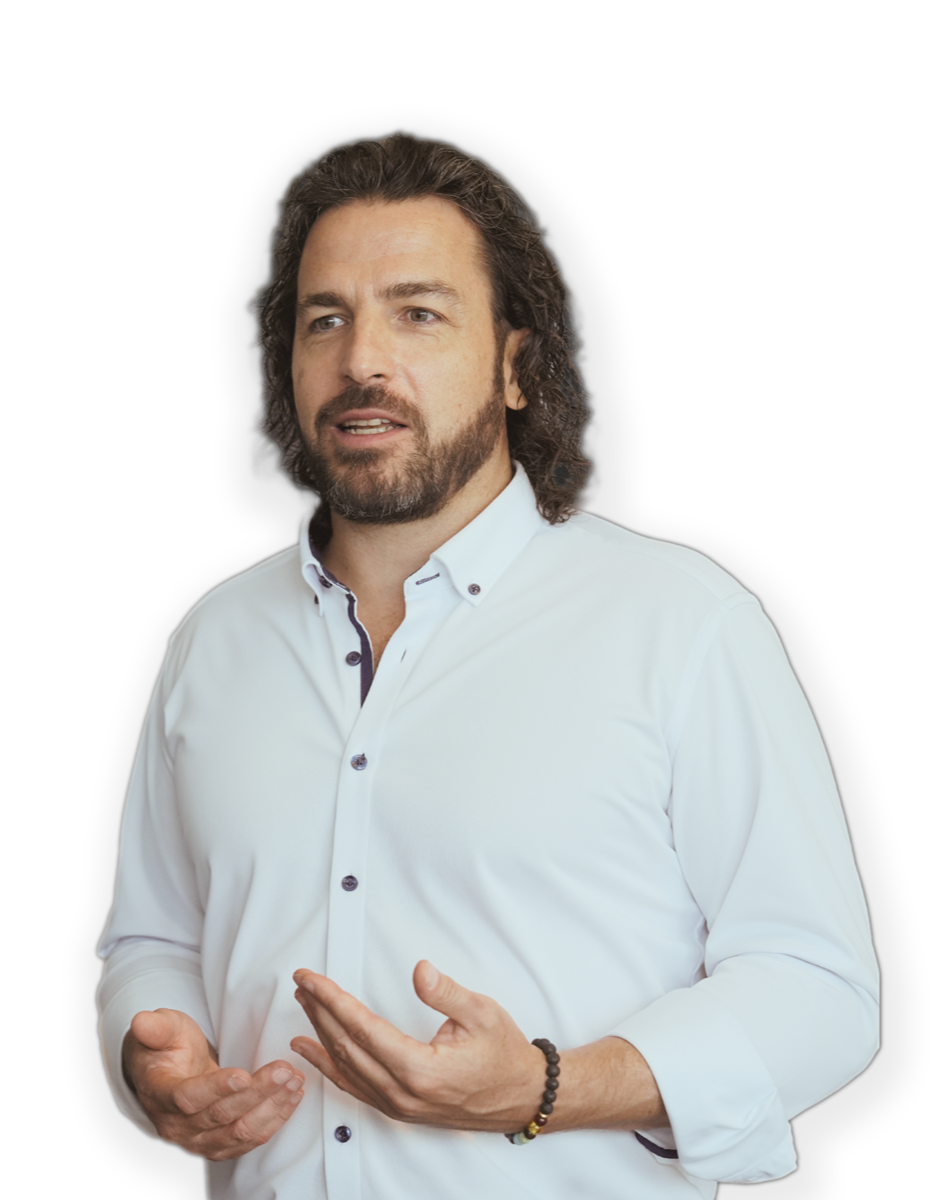
Dr Nikolas Epp
Researcher turned executive turned private advisor.
I believe in a world in which we live and work together better, both privately and professionally. I know from my own experience that this is possible when more people understand how they work and apply that knowledge in everyday life. That is what I work for.
PhD
SCIENCE
Studied chemistry and completed a PhD with distinction in cell biology at the German Cancer Research Center (DKFZ), with research at ETH Zurich.
15 years
CORPORATE EXPERIENCE
In leadership roles in industry, seven of them as an executive. I know the dynamics and pressure of competitive companies from my own experience.
30 years
THE HUMAN BEING
For three decades, I have studied how people perceive and decide, and why they so often act differently from how they intend.
Each year, I work personally with a limited number of accomplished individuals, leadership teams and business families.
The foundations of my work are scientific. The way I apply them is pragmatic and human.
YOUR NEXT STEP
Where would you like to begin?
Every path begins with a personal conversation. Not sure which programme is right for you, or looking for guidance tailored precisely to your situation? Then write to me. Your time is valuable. That is why I ask for a few brief details in advance, so that we can go straight to what matters to you.
I read every enquiry personally and reply within 48 hours. Everything you share with me remains confidential.
Or find out more about the individual programmes:
REFERENCES
1. Yu, W., Kwon, S.-W., Bokhari, K. and Bao, J. (2026): Unseen strain: how entrepreneurial pursuits undermine spousal well-being. Small Business Economics, Vol. 66.
2. Porter, M. E. and Nohria, N. (2018): How CEOs Manage Time. Harvard Business Review, July/August 2018.
3. Gallup (2026): State of the Global Workplace 2026.
4. Health Promotion Switzerland (2022): Job Stress Index 2022. Key figures on stress among the working population in Switzerland. Bern and Lausanne.
5. World Economic Forum (2025): The Future of Jobs Report 2025, Chapter 3: Skills outlook.
6. Arnsten, A. F. T. (2009): Stress signalling pathways that impair prefrontal cortex structure and function. Nature Reviews Neuroscience, 10(6), 410–422.